
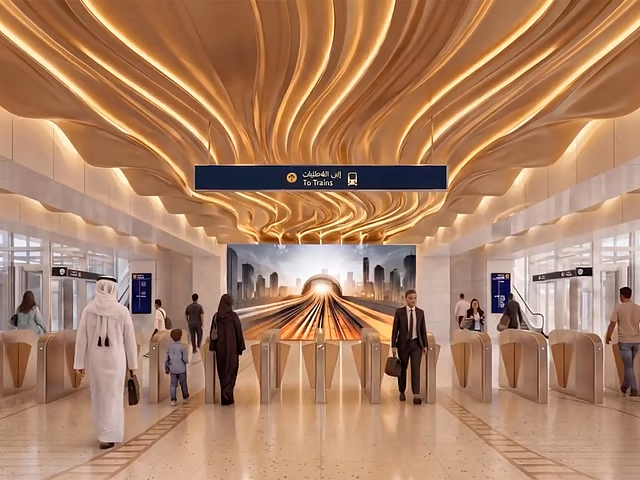
Dubai Metro Gold Line Set to Boost Property Values Across Key Residential Communities
Subheadline:
New Dh34 billion metro corridor expected to strengthen demand, improve connectivity, and increase long-term investment potential in Dubai’s fastest-growing neighborhoods.
Dubai’s real estate market is already responding to the announcement of the upcoming Dubai Metro Gold Line, with property experts forecasting stronger demand and higher property values across several of the city’s most active residential communities.
The Dh34 billion fully underground metro line will span 18 stations and connect 15 strategic destinations across Dubai. Among the communities expected to benefit the most are Jumeirah Village Circle (JVC), Mohammed Bin Rashid City (MBR City), Meydan, Al Barsha South, Business Bay, and Jumeirah Golf Estates.
Although the Gold Line is scheduled to open in September 2032, market analysts note that Dubai’s property sector typically begins pricing in major infrastructure projects years before completion. The confirmation of metro routes, station locations, and construction milestones often drives increased investor confidence, higher buyer demand, and stronger resale values well ahead of project delivery.
Mohammed Al Sari, Chief Development Officer at HRE Development, described the Gold Line as more than a transportation project, calling it “a value creation event” that is expected to reshape the investment landscape in several residential districts.
Jumeirah Village Circle is widely expected to be one of the biggest beneficiaries. Already one of Dubai’s highest-volume residential communities, JVC has long attracted investors and tenants due to its competitive pricing and strong rental demand. Direct metro connectivity is expected to remove one of the area’s few remaining limitations, making it even more attractive to both end-users and investors.
Mohammed Bin Rashid City and Meydan are also expected to experience significant gains. These premium master-planned communities have traditionally relied on road infrastructure despite their proximity to central Dubai. The addition of metro access is expected to further strengthen their appeal and support future price appreciation.
Al Barsha South is another community positioned to benefit as improved public transport links enhance accessibility and expand its appeal to families, professionals, and long-term residents.
Industry leaders believe that neighborhoods receiving metro service for the first time will experience the strongest uplift in demand and property values. According to Issa Atiq, CEO of Arabian Acres, communities such as MBR City, JVC, and Al Barsha South are among those expected to see the greatest transformation as connectivity improves.
Business Bay is also forecast to gain from the new route, particularly because of its planned interchange with the existing Red Line. Other strategic transport hubs, including Meydan and Jumeirah Golf Estates, are expected to benefit from future integration with Etihad Rail, creating seamless multimodal connections across the emirate.
Ajay Rajendran, Chairman and Founder of Meraki Developers, noted that properties located near metro stations and interchange hubs traditionally command the highest premiums due to improved accessibility, greater convenience, and stronger long-term investment fundamentals.
As Dubai continues to invest in world-class infrastructure, the Metro Gold Line is expected to play a significant role in shaping the city’s next phase of real estate growth. For investors, developers, and homebuyers, communities along the new corridor are increasingly being viewed as some of the strongest long-term investment opportunities in Dubai’s property market.